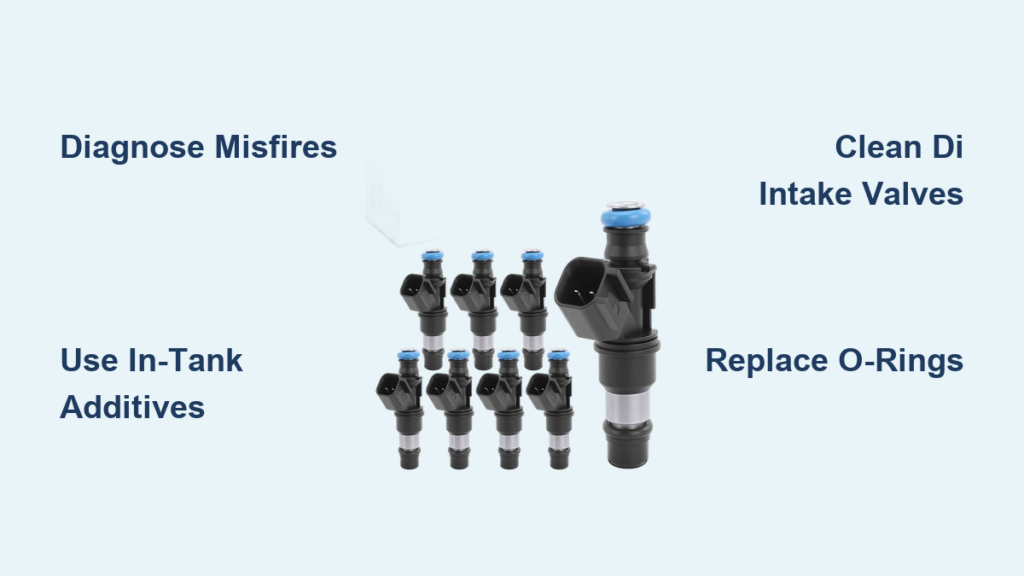
Your Chevy Silverado starts rough, hesitates on the highway, and the check engine light just flashed a P0308 code. Before you assume the worst, clogged fuel injectors are a common culprit, especially on 5.3L Direct Injection engines where carbon buildup happens fast. Left untreated, restricted injectors trigger misfires, kill fuel economy, and can even destroy your catalytic converter.
The good news? You can clean fuel injectors on a Chevy Silverado at home with the right method for your engine type. This guide covers diagnosis, three proven cleaning techniques, and maintenance tips to keep your truck running strong for years.
Diagnose Injector Problems Before Cleaning

Jumping straight to cleaning wastes time and money if the real issue is ignition or compression. Start with a systematic check to confirm clogged injectors are the actual problem.
Identify Common Symptoms
Watch for these red flags:
– Rough idle or shuddering at stoplights
– Sluggish acceleration or hesitation under load
– Check Engine Light with misfire codes (P0308 means cylinder 8)
– Reduced fuel economy and more frequent fill-ups
– Difficulty starting, especially when the engine is hot
A useful clue: spark plugs on the misfiring cylinder often look nearly new. A clogged injector starves the cylinder of fuel, creating a lean burn with minimal carbon residue.
Rule Out Ignition Issues First
Misfires often mimic injector problems. Isolate the cause with this quick test:
- Swap the coil and spark plug from the misfiring cylinder (e.g., cylinder 8) with a known-good one (e.g., cylinder 6).
- Clear the codes and drive the truck.
- If the misfire follows the swapped parts, you have an ignition issue.
- If the misfire stays on the original cylinder, suspect the injector or fuel system.
This five-minute test prevents unnecessary cleaning or part replacement.
Perform a Compression Test
Low compression mimics injector flow issues. Use a compression gauge and check all cylinders:
– Healthy reading: around 135 psi
– Acceptable variation: within 10% across cylinders
Consistent compression rules out internal engine wear and points back to fuel delivery.
Run an Injector Balance Test
This is the definitive test for clogged injectors:
- Connect a fuel pressure gauge to the Schrader valve on the fuel rail.
- Use a scan tool to run an injector balance test, which cycles each injector while measuring pressure drop.
- Benchmark: healthy injectors drop pressure from 55 psi to about 40 psi.
- Failure sign: a restricted injector drops only to 44 psi, a 4 psi deviation indicating poor flow.
If the bad pressure drop follows the physical injector even after swapping wiring, the injector itself is clogged or failing internally.
DIY Bench Cleaning for Removed Injectors
When injectors are severely clogged, bench cleaning restores flow by forcing solvent through the nozzle. This budget-friendly method works best on removed injectors and mimics professional service.
Gather Essential Tools
You will need:
– Brake cleaner or carburetor cleaner (CRC works well)
– Flexible tubing from a brake bleeding kit
– 9-volt battery (or a 12V source with caution)
– Heat shrink tubing and zip ties
– Compressed air
– New O-rings (always replace these)
– Injector harness adapter (optional but helpful)
This approach is commonly used on junkyard-sourced or pre-removed injectors.
Connect and Power the Injector
- Remove the old O-ring from the top of the injector.
- Slide flexible tubing over the nozzle. A dab of saliva eases the fit.
- Secure tightly with a zip tie and heat shrink to prevent blow-off under pressure.
- Attach the electrical connector or use jumper wires to the terminals.
Ensure all connections are secure. Pressurized cleaner can spray dangerously if tubing fails.
Flush with Cleaner
- Attach the free end of the tubing to the spray nozzle of the cleaner can.
- Power the injector with the 9V battery to open the solenoid.
- Spray cleaner through for 10 to 15 seconds.
- Release power, pause briefly, then repeat.
Complete 8 to 10 cycles per injector to fully dissolve varnish and debris.
Check Spray Pattern and Reassemble
After cleaning:
– Power the injector and observe the spray.
– Healthy pattern: even, conical mist.
– Clogged nozzle: uneven or dribbling spray.
If flow is still poor, repeat the cleaning or blow out the tip with compressed air. Always install new O-rings before reassembly. Old ones cause fuel leaks and vacuum issues.
Use In-Tank Fuel Additives for Mild Clogs
For mild buildup or preventative maintenance, in-tank cleaners are convenient and effective, especially on Port Fuel Injection (PFI) engines.
Choose the Right Cleaner
Top performers include:
– Chevron Techron or GM Fuel System Treatment Plus (same formula, different branding)
– AMSOIL P.I., used every 5,000 miles by enthusiasts
– BG 44K, known for strong detergent action
– Lucas Upper Cylinder Lubricant, which adds lubricity while cleaning
– Seafoam, safe for occasional use though less aggressive
These cleaners dissolve varnish and restore injector flow but cannot fix heavily clogged internal screens.
Follow a Proper Usage Schedule
- Preventative: add every 3,000 to 5,000 miles
- Active issue: use a full can in a near-empty tank, then fill up
- Best practice: combine with Top Tier gasoline, which contains higher detergent levels
For Silverados with PFI engines, this routine keeps injectors clean and performance sharp.
Know the Limitations
In-tank additives do not clean intake valves on Direct Injection engines. Since fuel bypasses the valves in DI systems, oil vapor from the PCV system builds carbon over time. Additives in the tank never reach these deposits, so do not expect them to fix DI-related hesitation or carbon coking.
Clean Direct Injection Intake Valves
On 5.3L DI engines, intake valve carbon is a silent killer. The only effective way to clean it is a top-down chemical flush while the engine runs.
Use Dedicated GDI Cleaners
Standard fuel additives will not work. You need products designed for direct intake application:
– CRC GDI IVD (Intake Valve Decarbonizer)
– Seafoam Motor Cleaner
– Gumout Regane or CLC Intake Cleaner
These solvents are sprayed directly into the intake stream while the engine runs.
Apply While the Engine Is Running
- Locate the PCV hose or throttle body intake.
- Disconnect the hose and insert the cleaner tube.
- Start the engine and hold RPM at about 1,000.
- Slowly spray the cleaner without flooding the engine.
- Let it idle for 10 to 15 minutes or until the can is empty.
The engine will emit thick blue smoke. This is normal as carbon burns off.
Drive to Clear Residue
After treatment:
– Take the truck for a hard drive on the highway or with wide-open-throttle pulls.
– This burns off remaining solvent and dislodged carbon.
– Avoid short trips immediately after.
Repeat every 20,000 to 21,000 miles or whenever performance dips.
Prevent Future Carbon Buildup

Cleaning is half the battle. Preventing recurrence, especially on DI engines, is key to long-term reliability.
Install an Oil Catch Can
The single best defense against intake carbon is a $150 oil catch can.
– Installed in-line with the PCV system
– Captures oil vapors before they reach the intake manifold
– Reduces carbon buildup by up to 80%
Check and empty the can every 2,000 to 3,000 miles, or install a permanent filtration system. Many Silverado owners report smoother idle and fewer misfires after installation.
Use Premium or E85 Fuel
- Premium gas (91+ octane) helps prevent knock and has been linked to resolving misfires when combined with cleaners.
- E85 (85% ethanol) acts as a powerful solvent. Running 2 to 3 tanks periodically cleans injectors and combustion chambers, which is great for high-mileage trucks.
Even if you do not run E85 full-time, an occasional tank can reset carbon levels.
Stick to Top Tier Gasoline
Brands like Shell, Chevron, and Mobil meet Top Tier Detergent Gasoline standards. They contain more effective detergents than standard fuel, reducing deposit formation in injectors and combustion chambers.
Make Top Tier your default fuel choice.
Replace Critical Components During Injector Work
Do not skip these small but vital parts when servicing injectors.
Always Replace O-Rings
Fuel and vacuum O-rings degrade over time. Reuse leads to:
– Fuel leaks, which create a fire hazard
– Vacuum leaks, which cause lean codes and rough idle
– Poor injector seating
Always install new O-rings when removing injectors. They cost less than $10 per set.
Inspect Electrical Connectors
Check for:
– Bent locking tabs
– Corroded terminals
– Cracked insulation
If damaged, replace the pigtail and solder new connections. Seal with heat shrink tubing for moisture resistance. A flaky connection mimics a dead injector.
Recognize When to Replace, Not Clean

Sometimes cleaning is not enough. Know when to call it quits.
Persistent Misfires After Cleaning
If misfires return:
– Recheck connector seating
– Test injector resistance (should be 11 to 16 ohms)
– Look for internal solenoid failure
A shorted coil or stuck pintle will not respond to cleaning. Replace the injector.
Uneven Spray After Multiple Cycles
If one injector sprays poorly despite repeated cleaning:
– Debris may be permanently lodged
– The nozzle may be physically damaged
Replace the set or at least the faulty unit. Mismatched flow rates hurt performance.
EVAP Codes Are Unrelated
Cleaning injectors fixes misfires, but EVAP codes (like P0440) stem from the emissions system. Do not assume they will clear. Diagnose them separately.
Follow Maintenance Intervals
Prevention beats repair. Stick to these schedules:
| Task | Interval | Notes |
|---|---|---|
| In-tank cleaner | Every 3,000 to 5,000 miles | Especially on PFI engines |
| DI intake cleaning | Every 20,000 to 21,000 miles | For 5.3L DI models |
| Catch can service | Every 2,000 to 3,000 miles | Empty or replace filter |
| Professional clean | Every 30,000 to 60,000 miles | Deep ultrasonic service |
| O-ring replacement | Every removal | Prevent leaks |
Regular care keeps your Silverado running like new, even past 100,000 miles.
Avoid Costly Engine Damage
Ignoring clogged injectors leads to bigger problems:
– Unburned fuel from misfires overheats and destroys catalytic converters ($1,500+ repair)
– Lean combustion increases cylinder temperatures, stressing pistons and valves
– Carbon buildup reduces airflow, power, and efficiency
– Premature engine wear shortens lifespan
A $20 can of Techron or a $150 catch can is cheap insurance against a $3,000 engine job.
Frequently Asked Questions About Cleaning Fuel Injectors on a Chevy Silverado
What are the symptoms of clogged fuel injectors on a Chevy Silverado?
Common signs include rough idle, sluggish acceleration, reduced fuel economy, difficulty starting, and check engine lights with misfire codes like P0308. Spark plugs on affected cylinders may appear nearly new due to lean combustion.
Can I clean fuel injectors without removing them?
Yes, for mild clogs on PFI engines, in-tank fuel additives like Techron or Seafoam can restore flow. For Direct Injection engines, intake valve cleaning requires spraying solvent into the throttle body while the engine runs.
How often should I clean fuel injectors on my Silverado?
Use in-tank additives every 3,000 to 5,000 miles for preventative care. For DI engines, clean intake valves every 20,000 to 21,000 miles. Schedule a professional ultrasonic cleaning every 30,000 to 60,000 miles.
Do fuel injector cleaners work on Direct Injection engines?
Standard in-tank cleaners cannot reach intake valves on DI engines because fuel bypasses them. You need dedicated products like CRC GDI IVD sprayed directly into the intake while the engine runs.
How much does it cost to clean fuel injectors professionally?
Professional ultrasonic cleaning typically costs $150 to $300 for a full set. DIY bench cleaning costs under $30 in supplies, while in-tank additives run $10 to $25 per treatment.
Will cleaning fuel injectors improve gas mileage?
Yes, if poor spray patterns were reducing atomization. Restoring proper flow typically improves fuel economy by 1 to 3 mpg, especially when combined with Top Tier gasoline and a catch can.
Key Takeaways for Cleaning Fuel Injectors on Your Chevy Silverado

Start with diagnosis to confirm clogged injectors before spending time or money. Use the injector balance test (55 psi to 40 psi benchmark) as your definitive check. Match your cleaning method to your engine type: in-tank additives for PFI, top-down intake cleaning for DI, and bench flushing for severely clogged removed units.
Prevention is cheaper than repair. Install a catch can, use Top Tier fuel, and stick to additive schedules. Replace O-rings every time you remove an injector, and know when to replace rather than clean.
Your next step: grab a can of Techron for a quick tune-up, or schedule an injector balance test if you are already experiencing misfires. Either way, acting now protects your catalytic converter and keeps your Silverado running strong.