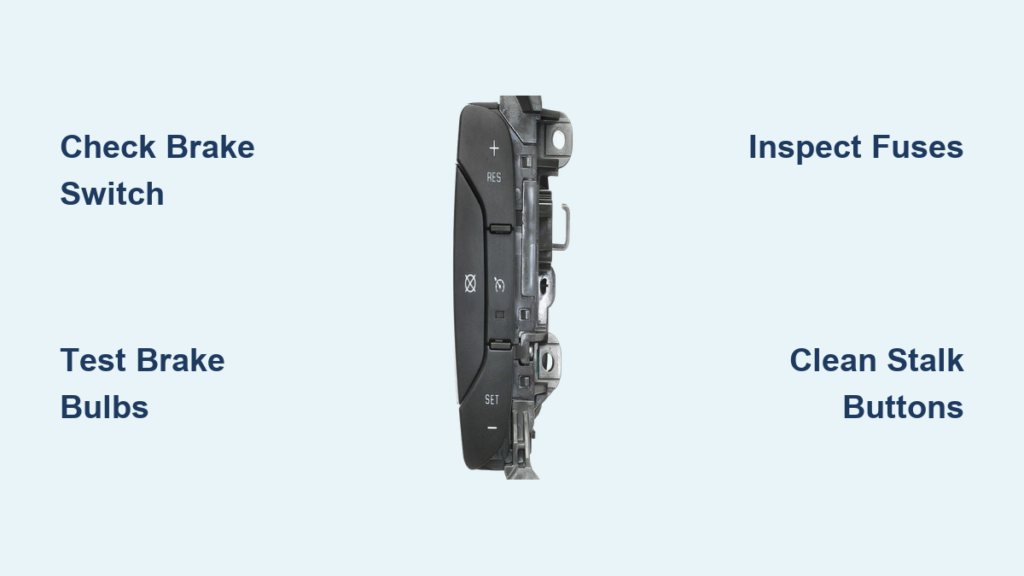
A Chevy Silverado cruise control not working can turn long highway drives into a chore. This frustrating issue affects models from the 1990s through 2018 and beyond, and it often strikes without warning. The good news is that the problem is rarely caused by a failed computer or expensive electronics. In most cases, simple, low-cost components are to blame, especially parts within the brake light circuit.
This guide walks you through a proven diagnostic path to fix your Chevy Silverado cruise control not working. You will start with the most common causes and move toward advanced checks, saving both time and money along the way.
Check Cruise Control Prerequisites First
Before diving into hardware repairs, confirm that basic operational conditions are met. Many drivers overlook these simple checks.
Verify Activation and Speed Threshold
Ensure the cruise control “On/Off” button is engaged. A green “Cruise” light should appear on the dash when activated. This step is easy to miss, especially after battery replacements or electrical resets.
Also, remember that cruise control will not engage below 25 mph. Attempting to set speed at lower speeds triggers no response. This is normal behavior, not a fault.
Inspect for Warning Lights
An illuminated Check Engine light disables cruise control on Silverados with Electronic Throttle Control (ETC), common in 2007 and newer models. Use an OBD2 scanner to check for trouble codes. Key codes related to cruise failure include:
- P0500: Vehicle Speed Sensor (VSS) malfunction
- P0501: VSS range or performance issue
- C0500: Cruise control system failure
Clearing these codes may restore function, but only after fixing the root cause.
Test the Brake Light Circuit
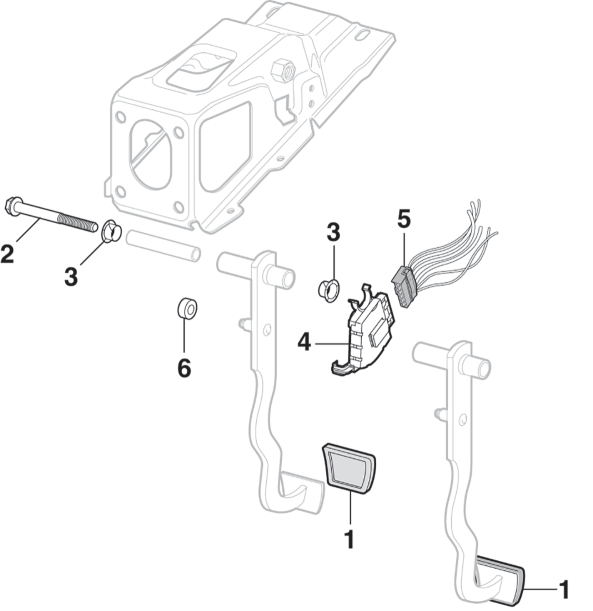
The brake light circuit is the number one cause of cruise control failure in Silverados. The system monitors this circuit continuously and disables cruise if it detects any anomaly.
Replace the Brake Pedal Switch
The brake pedal switch (also called the stop light switch) is the most frequent culprit, especially in 2007–2013 models. This switch signals when the brake is pressed. If it fails or sticks, the system thinks the brakes are always applied, disabling cruise entirely.
Common symptoms include:
- Cruise will not engage
- Brake lights may flicker or stay on
- Intermittent operation where cruise works only sometimes
How to test the switch:
- Press the brake pedal and listen for a click near the pedal arm.
- If no click occurs, the switch is likely dead.
- Manually push the brake pedal up to its full stop. A sticky return spring can prevent full release and keep the switch engaged.
Replacement steps for 2007–2013 models:
- Locate the switch on the brake pedal shaft.
- Loosen the 10mm bolt securing it.
- Slide the switch down and out of the bracket.
- Unplug the wiring harness by pressing the small tab.
- Install the new switch, reconnect the harness, and tighten the bolt.
- Test cruise function above 25 mph.
Cost: $15–$25
Time: 15 minutes
Success Rate: Approximately 90% for 2007–2013 models
This switch contains multiple internal contacts: one for brake lights, one for cruise disable, and one for torque converter lockup. The cruise contact can fail even when brake lights work normally.
Check All Brake Light Bulbs
A single faulty bulb can disable cruise control. Inspect every brake light on your truck:
- Left and right tail lights
- Center High-Mounted Stop Lamp (CHMSL) at the top of the cab
There are documented cases where only the CHMSL was out, yet cruise refused to engage. Replace any burnt bulbs immediately, even if the others appear to work.
Address LED Brake Light Compatibility Issues
Aftermarket LED brake lights draw less current than incandescent bulbs. On 2018 and newer Silverados, the control module may detect this low draw as a “bulb out” condition and disable cruise.
Fix options:
- Revert to factory incandescent bulbs
- Install LED bulbs with load resistors or CANbus compatibility
Inspect Relevant Fuses
Check fuses in both the under-hood and dash fuse blocks. Key fuses to examine include:
- Cruise Control Fuse (typically 10A)
- CHMSL Fuse
- Brake Light Fuse
Even if a fuse looks intact, test it with a multimeter. A hairline crack can break the circuit without visible damage.
Diagnose Steering Wheel Controls
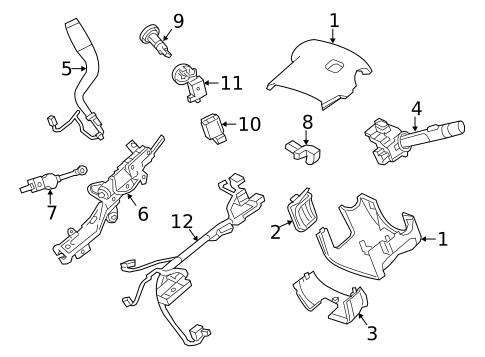
If brake lights and switches are functional, the next suspect is the steering column.
Test the Cruise Control Stalk
The cruise control stalk or wheel buttons send “Set,” “Resume,” and “Cancel” commands. Over time, internal contacts corrode or wires break from constant movement.
Symptoms of stalk failure:
- “Set” works but “Resume” does not
- No response from any button
- Intermittent function
Quick fix: Spray DeOxit D5 contact cleaner into the stalk or button seams while pressing the controls repeatedly. This often restores function by cleaning oxidation.
If cleaning fails: Replace the entire stalk assembly. Used units from junkyards cost $30–$100 and are typically plug-and-play.
Check the Spiral Cable (Clock Spring)
On 2018 and newer models with wheel-mounted buttons, the spiral cable maintains electrical connection between the steering wheel and column. If damaged, it breaks the signal path to the cruise buttons.
Symptoms include:
- Cruise buttons stop working
- Airbag light may illuminate
- Horn or audio controls fail
A professional scan tool can detect spiral cable faults. Replacement requires airbag removal and is best handled by a technician.
Verify the Vehicle Speed Sensor
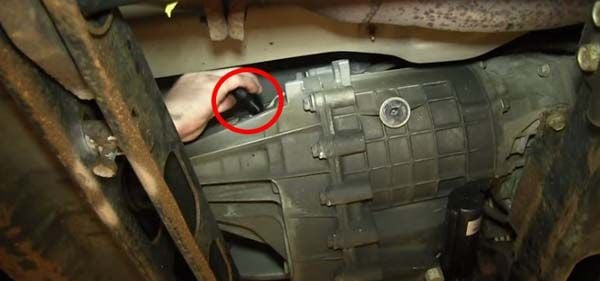
The cruise control module needs accurate speed data to function. A failing Vehicle Speed Sensor (VSS) sends erratic or no signal, preventing cruise engagement.
Test the VSS Signal
Check for diagnostic trouble codes P0500 or P0501. On older trucks with a legacy 10-pin module, you can perform a voltage test:
- Unplug the cruise control module.
- Turn ignition to “On” without starting the engine.
- Measure Pin K with a multimeter.
- Drive at 30 mph and check AC voltage.
Expected reading: Approximately 9V AC
Problem indicator: Less than 1V AC suggests a VSS or wiring issue
Resolution: Replace the VSS (located on the transmission or rear axle) or inspect wiring for damage and corrosion.
Inspect the Vacuum System on Older Models
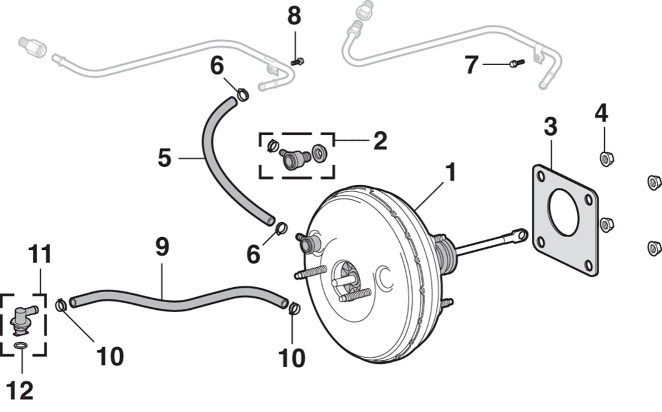
Pre-2007 Silverados with carbureted or throttle body injection systems use vacuum actuators for cruise control.
Check for Vacuum Leaks
Symptoms of vacuum issues:
- Cruise engages but will not hold speed
- High idle
- Hissing sounds under the hood
Inspection steps:
- Locate the vacuum servo (usually near the firewall).
- Follow the vacuum lines to the intake manifold.
- Look for cracks, brittleness, or disconnections.
- Spray soapy water on hoses. Bubbles indicate leaks.
Test the servo: Apply vacuum with a hand pump. It should hold vacuum for at least 30 seconds. If it leaks down, replace the servo.
Repair or Replace the Cruise Control Module
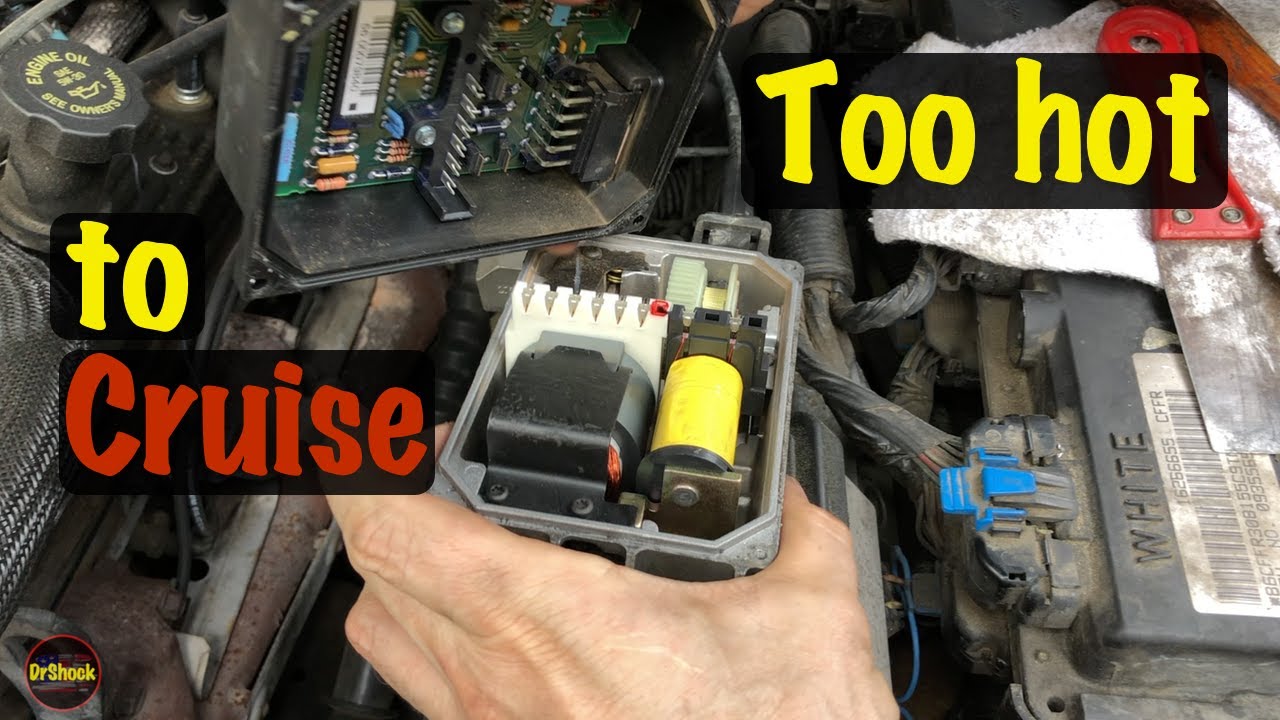
Module failure is rare but possible, especially in older trucks with high mileage.
Fix Cracked Solder Joints
On 1990s and early 2000s models, the under-hood cruise control module is prone to cracked solder joints where the heavy connector attaches to the circuit board.
Symptoms include:
- Intermittent cruise function
- Tapping the module restores operation
- Wiggling the harness turns cruise on or off
Repair steps:
- Remove the module (usually near the master cylinder).
- Open the case with a T-15 Torx screwdriver.
- Inspect solder joints on the connector side.
- Re-flow cracked joints with a soldering iron.
This repair costs nothing and fixes the issue in many cases.
Swap Circuit Board from a Junkyard Module
If soldering is not an option, buy a used module and swap the circuit board into your existing housing. Boards from salvage yards cost $8–$65 and are often plug-compatible.
Model-Specific Fixes
2007–2013 Silverado (NNBS)
Primary fix: Replace the brake pedal switch. This solves 90% of cases.
Pro tip: After replacement, push the brake pedal fully to ensure the switch resets properly.
2008 Silverado
Dual suspects: Brake switch and steering stalk. Also check the VSS, as this model year shows higher sensor failure rates.
2018 Silverado LT
Likely causes:
- Spiral cable failure
- LED brake light incompatibility
Avoid non-CANbus LEDs. If cruise stops after a lighting upgrade, revert to factory bulbs.
1990–1994 (GMT400)
Common issues:
- Broken wires inside the cruise stalk
- Cracked solder joints in the under-hood module
Fix: Cut open the stalk insulation and inspect for broken wires. Solder and heat-shrink any damaged sections.
Final Checks and Safety Testing
After any repair, test the system safely before relying on it.
Validate System Operation
- Drive above 25 mph on a clear road.
- Press “On,” then “Set.”
- Confirm cruise engages and holds speed.
- Tap the brake pedal. Cruise should disengage immediately.
- Test “Resume” after braking.
Warning: Never assume the system works. A cruise control that fails to disengage is dangerous.
When to See a Mechanic
Seek professional help if:
- Basic checks (bulbs, switch, fuses) do not fix the issue
- VSS or wiring harness damage is suspected
- Spiral cable or module internal fault is confirmed
- You are uncomfortable working with electrical systems
A skilled technician can perform live data scans and pinpoint signal loss in real time.
Frequently Asked Questions About Chevy Silverado Cruise Control
Why does my cruise control not work but my brake lights do?
The brake pedal switch contains multiple internal contacts. One set controls the brake lights, while another sends the cruise disable signal. The cruise-specific contact can fail even when brake lights function normally. Replacing the switch usually resolves this issue.
Can a burnt-out brake light bulb disable cruise control?
Yes. The system monitors the entire brake light circuit. If any bulb is out, including the center high-mounted stop lamp (CHMSL), the control module interprets this as a safety hazard and disables cruise. Always check all three brake lights before investigating other causes.
Will a Check Engine light turn off cruise control?
On Silverados with Electronic Throttle Control (2007 and newer), any active powertrain fault triggering a Check Engine light will inhibit cruise operation. Use an OBD2 scanner to retrieve trouble codes and address the underlying issue before expecting cruise to work.
How much does it cost to fix cruise control on a Silverado?
Most fixes cost under $50. The brake pedal switch, the most common solution, costs $15–$25 and takes about 15 minutes to install. Steering stalk replacements from junkyards range from $30–$100. Professional diagnosis is recommended for complex electrical issues.
Can LED brake lights cause cruise control problems?
Yes, on 2018 and newer Silverados. LED bulbs draw less current than incandescent bulbs, which can trick the control module into detecting a “bulb out” condition. To fix this, revert to factory bulbs or install LED bulbs with load resistors or CANbus compatibility.
Is it safe to drive with cruise control not working?
Yes, it is perfectly safe. A malfunctioning cruise control simply will not engage or will disengage unexpectedly. However, if cruise fails to disengage when you press the brake, stop driving and seek professional repair immediately, as this poses a serious safety risk.
Key Takeaways for Fixing Chevy Silverado Cruise Control
Start with the brake light circuit. For 2007–2013 models, replacing the $20 brake pedal switch solves roughly 90% of cruise control failures. Check all brake bulbs, including the CHMSL, and verify relevant fuses before moving to more complex diagnostics.
If the brake circuit checks out, inspect the steering wheel stalk and buttons. Contact cleaner can restore function in many cases. For persistent issues, test the vehicle speed sensor and consider vacuum leaks on older models.
Most repairs cost under $50 and take less than 30 minutes. Do not replace the computer first. Start with the brake switch. It is almost always the answer to a Chevy Silverado cruise control not working.